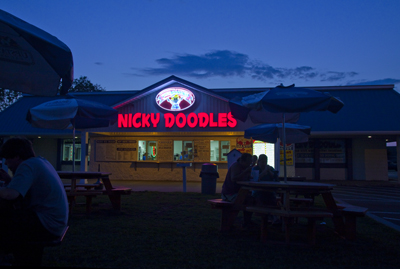
Balancing the lights on a building with the light of the sky can lead to many interesting photographs. To do this, you want to start photographing just after sunset. Start out with an exposure that correctly exposes the building lights. At first, right after sunset, the sky will be much too bright. As the minutes pass by, the light intensity of the sky will be falling. Somewhere between 10 and 25 minutes after sunset, you will find that the light intensity of the sky pretty much matches the light intensity of the building lights. This is the magic moment you want to take your picture.
This photo of a popular local ice cream shop was taken about 20 minutes after sunset, just when the intensity of the sky matched the light intensity of the sign on the building. A tungsten light balance was set so the sky would show up as a fairly deep blue. This is a technique I learned from David Hobby's Strobist website.
This photo was taken on a Canon 50D with a Canon EF-S 15-85mm lens. The lens was set to 19mm and the exposure was at f/5.6 for 1/30 sec. (ISO 400).
Learning to balance light in a wide variety of situations is an important element in good photography. These exercises are helping me to become a better photographer.
Showing posts with label Photo Lighting. Show all posts
Saturday, May 26, 2012
Saturday, December 26, 2009
Christmas Morning Photos
This Christmas morning I tried out an off camera, multi-light setup that I learned from David Hobby on his Strobist blog. This setup worked great! Here is a sample of my grandchildren playing with their new Wii video gaming system. 
Based on the information I learned on Strobist, I used two Nikon SB-26 electronic flash units placed in opposite corners of the room. Each flash unit was mounted on a light stand and aimed at the ceiling from about a foot away. The flash units were set on manual, and set to 1/2 power. One flash was connected to a PocketWizard Plus II, and the other was set to use its internal optical slave. Photos were taken with a Canon 5D Mark II and the remote flash was triggered by a PocketWizard TT1 (for Canon) unit.
The walls were light beige in color, and they, along with a table lamp, added a slight warming to the light
I am learning a great deal about photographic lighting from Strobist. I recently purchased a set of DVD's on photographic lighting by Dean Collins, one of photography's greatest lighting innovators. I learned about him and found the link to purchase these DVD's in a Strobist article about Collins.
Based on the information I learned on Strobist, I used two Nikon SB-26 electronic flash units placed in opposite corners of the room. Each flash unit was mounted on a light stand and aimed at the ceiling from about a foot away. The flash units were set on manual, and set to 1/2 power. One flash was connected to a PocketWizard Plus II, and the other was set to use its internal optical slave. Photos were taken with a Canon 5D Mark II and the remote flash was triggered by a PocketWizard TT1 (for Canon) unit.
The walls were light beige in color, and they, along with a table lamp, added a slight warming to the light
I am learning a great deal about photographic lighting from Strobist. I recently purchased a set of DVD's on photographic lighting by Dean Collins, one of photography's greatest lighting innovators. I learned about him and found the link to purchase these DVD's in a Strobist article about Collins.
Labels:
Electronic Flash,
Off Camera Flash,
Photo Lighting
Subscribe to:
Posts (Atom)
